Our History
Paul Wilkes, Founder
My work in India began in February, 2006, on a blazingly hot afternoon in Kochi, India. It began quite by accident. Or, thinking back, perhaps it wasn’t an accident at all. My wife Tracy and I were in middle of a trip of a lifetime, four weeks in India. We had come to the city of Kochi in South India and checked into still another well-appointed hotel.
Our driver picked us up promptly at nine, after we had finished a sumptuous breakfast. In our air-conditioned car, he showed us the oldest synagogue in this part of the world, unique Chinese fishing nets, a vibrant merchants’ quarter. He was a perfect gentleman and wanted to do nothing to spoil our visit to his city. He talked proudly of Kochi’s past and present; he said nothing about the poverty that was all about us, the crippled, the maimed we saw, so many children begging on the streets, shacks made of scraps of metal and plastic. It was two o’clock, we still had time in his service; what would we like to see or do, he courteously requested? Where my reply came from I will never fully know. “I’m Catholic,” I blurted out: What is my church doing to alleviate this grinding poverty, to help these poor people?” He was a professional driver and guide. I don’t know if he had been asked the question before, but he hesitated before answering. “I could tell you. But, if you don’t mind, sir, I’ll show you…
We drove down Mohandas Gandhi Road, turned off at Binny Road, a narrow lane in a poor neighborhood that had once been a swamp. He stopped at the metal gates of Prathyasha Bhavan, (Home of Hope), a home. The gates swung open and a group of girls came running toward us, laughing, waving their hands in welcome. They were well dressed, clean, and apparently happy. We were offered a tour of the home by one of the Salesian sisters, a member of the religious order of women who had founded the home thirty years before. It was soon apparent my first impression was wrong. This was a very poor place. The children were sleeping on the concrete floor of a school assembly hall, simply because there was no other room for them. The sisters were a bit shy, but finally admitted that at times they had difficulty feeding the ever-growing number of children, 75 of them that day. The home was living on the threshold of mere survival. And yet, we were asked for nothing and offered tea and cookies in the nun’s small refectory.
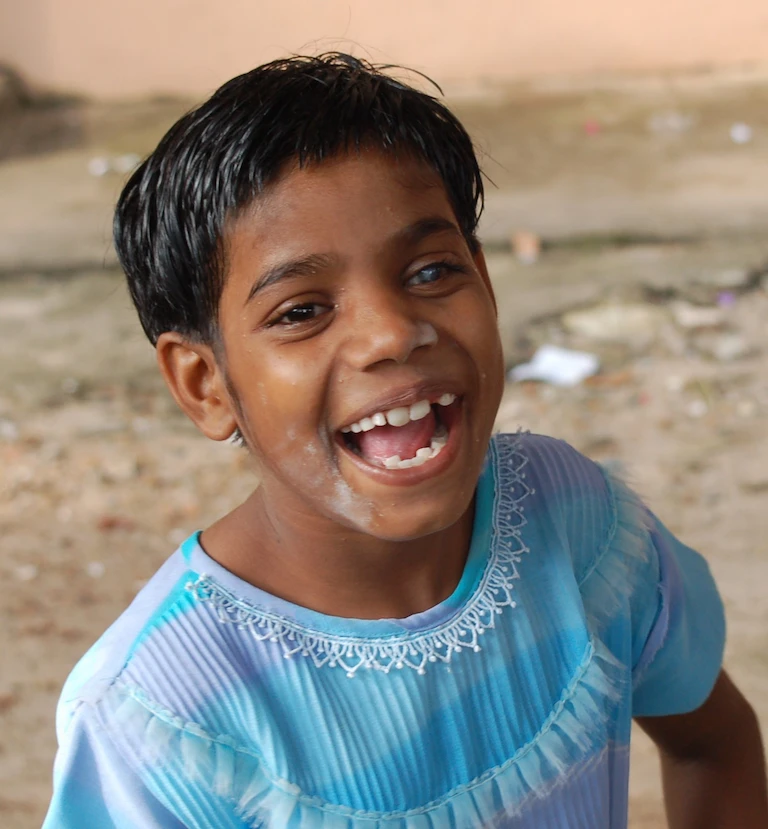
We came outside into the hot sun and I was reaching into my pocket to offer a donation. There, on the dusty playground, a tiny girl stood in the shadow of one of the nuns, Sister Sophy Joseph. The little girl, named Reena, was wearing sunglasses. None of the other girls was wearing sunglasses and I asked why this child was wearing them. Sister Sophy took off the sunglasses. One of Reena’s eyes was perfect, dark, bright. The other eye was terribly scarred and dull. Sister Sophy told us why.
Reena had been begging on the streets with her mother, who was mentally ill. They were separated in the downtown crowds. Reena was kidnapped by the “beggar mafia,” who held her down hand and foot, and plunged a darning needle into her eye. They wanted her not only to be a beggar, but a “better” beggar to bring them even more money. This was years before the movie “Slumdog Millionaire” portrayed this kind of cruelty to children. I looked down in horror. Little Reena returned my look with the most beatific, trusting smile I had ever seen. Something happened. I don’t know exactly what. But I knew that the rupee notes I was pulling out of my pocket to hand over to Sister Sophy were not enough, not nearly enough. Home of Hope needed far more than that. I needed to do more than leave a donation behind, get back into my air-conditioned car and go on with my comfortable air-conditioned life. But what? And, more importantly, how? I was a free-lance writer. What was I, one person, going to do? The needs were so profound. Where could a person even begin? But if not me, who?
Oddly enough, our next stop on our India trip was not a typical tourist destination but Kurisumala, an ashram of Trappist monks, high in the mountains three hours from Kochi. I wrote about that visit, but what is not in that story was the mental video that kept replaying in my head. Reena’s story. My shock. Her radiant and trusting smile. We only had a short time when we returned to Kochi, before getting on a plane to continue our journey, but I knew I had to see Home of Hope again. This time, when I drove through the gates, and the girls came running toward us, I had a feeling I had come home. Home…to Home of Hope. Remember, I had only been here for less than an hour the first time. I looked upon Reena once again. And again, there was that trusting, loving smile. I found these words forming in mind, but I was neither bold nor sure enough to say them out loud: “Reena, somehow, some way, I want to — I AM – going to make your future better than your horrible past.”
Before I left, I took Sisters Sophy and Thresia aside and told them we would not forget them.
Little did I know that since that day, my life would dedicated, first to those orphan girls and sisters in Kochi, but eventually to the thousands of girls who have found a safe haven at one of our Homes of Hope throughout India.
When I got back to the United States I began to tell my friends about meeting Reena and her trusting smile. I found myself relating the story over and over, to anyone who would listen. I could see that Reena’s story made the same impact it had made on me. It was almost as if people were ready to help, but I didn’t know what to ask for, what to do. My mind kept going back to that concrete floor where the children slept each night, on a thin straw mat. I would start there.
That Christmas, I sent out a letter to my friends, asking them to contribute for “A Bed for Reena.” We would buy foam mattresses and coverlets so the girls could at least get off that hard concrete floor. I collected about $3,000. It was a start, and as it would turn out, a foolish one.
As it turned out the mattresses were a terrible idea. There was no place to store them during the day. The space was too crowded and the floor too dirty to keep them clean. But the work had begun, and energized by the heartfelt response from my friends, I pressed on. I am a journalist and was working on my next book, but supplementing my income by teaching at the University of North Carolina at Wilmington. I had begun to be eligible for Social Security and as I looked at how much I was earning as a part time teacher and what the Social Security check would be there was not a great difference in the amount. Where the great difference was, was time. I was at a point in my life, sixty-eight years old, my children out of the house, and as I knew, with more years behind me than before me. As I would begin to acknowledge: there was only so much oil left in my well…how did I want to pump it….and where did I want to use it?
Reena’s smile held the answer. The map of our Homes of Hope locations provides a vivid picture of the impact of our work throughout India. With generous support from people, corporations, foundations, civic and religious groups all over the world, Homes of Hope India-US has made a profound difference in the lives of thousands of children and young women.
And just think: it all started with a little girl’s smile.

Contact Us
Board of Directors and Staff
Patricia Bennett
Entrepreneur/Optimist/Driven to Excellence
Barbara J. Bush, Treasurer
Retired Accountant
John Clegg, Chairman
Entrepreneur
Robert C. Davis
CEO-Process Control Solutions
Jim Fienup
University Professor / Scientist
Glen Gaidos
Strategic Advisor
Rupa Grummon
Nurse Practitioner
Patrick W. Marriott, Secretary
Retired General Electric Executive
Janice O’Neill
Human Resources Executive
Joseph Tallarico
Retired Unilever Executive
Carol Skoglund
Executive Director
Paul Wilkes, Founder
Videos
A Certain Smile: Giving Hope to the Orphan Girls of India
HOMES OF HOPE: What We Are About
A Chance For A New Life
A Visit to Home of Hope
HOMES OF HOPE: From Streets to Safety


Barbara Bush retired from WHQR Public Media in Wilmington, NC after serving 17 years as Finance Director. In her role, she worked with the WHQR Board, community partners, colleagues, and volunteers. Barbara volunteers on boards and committees in her community and joined Homes of Hope in 2025.
Bob Davis is the owner of Process Control Solutions, a small business selling and servicing industrial and life science equipment through the Northeast United States. He has been involved with Home of Hope since 2007 as a board member and mission appeal speaker. In 2008, Bob travelled to Kochi to visit and meet the young women and sisters of the orphanage there. He is married and has three children, all of which he hopes to bring to India to see our work.
Carol Skoglund lives in Cleveland and joined Homes of Hope in January 2025 after receiving a call from Janice on the board. The two first visited India together as college students. Early in 2025, Carol returned to India to tour ten Homes of Hope locations.
Jim Fienup is the Robert E. Hopkins Professor of Optics at the University of Rochester. He is one of the pioneers in unconventional optical imaging, which has uses in medicine, astronomy, and many other fields. While in India for an optics conference in 2011, he visited two Homes of Hope locations and has been involved in our work since then. He and his wife, Patty, have four grown sons and four grandchildren.
Glen Gaidos is an entrepreneur, investor, and writer. In 2003, he launched 3R Technology with the mission of improving technology lifecycle management and keeping electronics out of the landfill. Glen came to serve our board in 2017, after 3R Technology donated refurbished laptops to provide technology access for the orphanages. When not working on his various endeavors, he enjoys volunteering, hiking, paddle-boarding and playing music.
Rupa Grummon was born in New Delhi, India. She was adopted at birth by an Indian couple who had already emigrated to the United States, so she has a special place in her heart for orphan girls. Rupa earned two masters degrees in nursing and has worked as a critical care nurse and cardiology nurse practitioner. She and her husband Charles, children Sophie and Xander, live in Brentwood, TN. They found Homes of Hope through an Internet search and are generous supporters. They hope to visit India soon.
Brenda Marcoux is a 4th grade teacher in Shirley MA. She is married and the mother of two children and one exchange daughter from Seoul, South Korea. Brenda taught in our school in Warangal, India during the summer of 2010.
Pat Marriott retired from the General Electric Company in 1999, after a 33-year career in management and senior executive positions, to devote himself to voluntary public service. He is a program producer and host at WHQR, the NPR station in Wilmington NC; the music librarian for Mepkin Abbey, a Trappist monastery; and serves as an officer on several nonprofit boards of directors.
Janice O’Neill is a Human Resources Executive with a specialty in Talent Development. Her career has focused on building and enabling high performance organizations. Janice first visited India as a college student and knew she would be back. She visited our Kochi orphanage in 2014 with her daughter and made a visit to one of our Bangalores home in 2022 with business colleagues.

Joe Tallarico joined the Homes of Hope Board of Directors in 2015. After meeting Paul in West Virginia in 2014, Joe, his wife and his generous daughter immediately began contributing in various ways. In 36 years with Unilever, Joe has held leadership positions in sales, marketing, training, and information technology. He is a worldwide consultant to the food industry.
Glenn and his lovely wife Mary reside in Wilmington NC. They are active in their local church parish where Mary currently serves as the office manager. Glenn enjoys the recreational opportunities the Wilmington / Wrightsville Beach area affords and can be found surfing, practicing yoga with Mary, or riding his motorcycle when he’s not working at the General Electric Nuclear Energy site where he’s been for the past 16 years leading manufacturing and quality departments.
Paul Wilkes is a journalist, writer and social entrepreneur. He founded Homes of Hope in 2006 after a visit to our orphanage at Kochi and meeting Reena, who had been blinded to make her a better beggar. He has written for The New Yorker, the New York Times Magazine and many other publications in addition to his work as a documentary film producer, director and writer. He is the author of over twenty books. His wife Tracy founded DREAMS of Wilmington, a character development program for at-risk youth that uses the arts to build self-esteem and discipline. They have two grown sons.
Lauren became involved with Homes of Hope after visiting and volunteering at the Homes of Hope in Kochi and in Secunderabad in early 2015. Lauren has returned to India on multiple occasions to visit and volunteer with Homes of Hope while finishing her master’s degree in social work. Lauren became the Program Coordinator for Homes of Hope – India in March of 2017 and plans to return to India again as soon as possible (she would move there if she could but she has two dogs who wouldn’t be allowed to make the journey).